.webp)
August 11, 2026
Short answer: no. A federal judge in Texas ruled on August 5, 2026 that the extra paperwork required to buy a suppressor or a short-barreled rifle is unconstitutional, but the ruling only protects the specific people and groups who sued and it is on hold pending appeal. Walk into a gun shop today and you will go through the exact same process you would have gone through in July.
Since 1934, buying a suppressor or a short-barreled rifle has meant a separate federal process on top of a normal gun purchase: an application to the ATF, fingerprints, a passport photo, registration of the item in a federal database, a $200 tax, and a wait that has historically run weeks to months.
In 2025 Congress dropped that $200 tax to zero, effective January 1, 2026. It kept all the paperwork. A group of gun owners, companies, organizations, and states sued, arguing that the paperwork only ever existed to help the government collect a tax, so once the tax hit zero the paperwork lost its legal footing.
On August 5, a federal judge in Texas agreed with them.
Four categories, and only four:
Machine guns and destructive devices are not included. Congress kept the tax on those, so the judge's reasoning does not reach them. Nothing about full-auto changed.
This is the part that trips everyone up, and it is the whole ballgame.
The judge did not strike the law down for the entire country. Under a 2025 Supreme Court decision, federal district judges can no longer issue rulings that protect everybody in America. They can only fix the problem for the people standing in front of them. So the protection here follows the plaintiffs, not the map.
The plaintiffs fall into three buckets:
So the honest answer to "am I covered" is: maybe, and figuring it out is not something to do from a Reddit thread.
Even for people who are arguably covered, there is a practical wall.
Your dealer is the one who has to hand you the item, and their federal license is what gets destroyed if they get it wrong. The ATF has not issued new guidance to dealers. Until it does, no responsible shop is going to transfer a suppressor over the counter on the strength of a district court ruling that is still being appealed. That is not timidity, it is arithmetic: their business against your convenience.
On top of that, the judge paused his own ruling for seven days so the government could go to the Fifth Circuit Court of Appeals. That pause runs out on or about August 12, 2026. The Justice Department can ask the appeals court to keep it paused for as long as the appeal takes, which could be a year or more.
Here is the before and after for a suppressor purchase, for buyers the ruling actually covers:
| Buying a suppressor | Today | If it survives |
|---|---|---|
| Background check | Required | Still required |
| ATF Form 4473 at the dealer | Required | Still required |
| Government photo ID | Required | Still required |
| Name and serial number in a federal registry | Required | Gone |
| Separate ATF application (Form 4) | Required | Gone |
| Fingerprints and passport photos | Required | Gone |
| $200 tax stamp | Already $0 since Jan 1, 2026 | Still $0 |
| Wait time | Weeks to months | Same day |
In plain terms: it would turn a suppressor into a normal over-the-counter gun purchase. It would not turn it into a no-questions-asked purchase.
No, not as an ordinary member of the public. The tax has been $0 since January 1, 2026 anyway. The part that actually costs you time, the application and approval process, is still in place for anyone outside the ruling.
No. One federal district judge declined to enforce parts of it against the people who sued him over it. That is a long way from gone.
Not automatically. Living in a plaintiff state does not put you inside the ruling. Membership in one of the plaintiff organizations, or buying from one of the plaintiff companies, is a stronger argument, and still not one to bet a felony conviction on while the appeal is pending.
Treat the answer as no. Making an unregistered SBR is a federal felony, and "a judge in Texas said the registration rule was unconstitutional" is a rough thing to explain to a jury while the case is still on appeal.
Nothing different. Follow the process your dealer walks you through. If the rules genuinely change, it will happen loudly and in writing, and every gun shop in the country will know before you do.
I like this ruling, and not only on the law.
I am a fan of short-barreled rifles. A reliable, quality, affordable 11.5" AR-15 is one of the best home defense tools a normal person can own, and I would have no problem with it being someone's first gun. It is easier to shoot well than a handgun, easier to move around a house with than a full-length rifle, and far more forgiving under stress. Pistol-caliber carbines get the same benefit. Put a stock on a 9mm and you have a gun a new shooter can actually brace and hit with, instead of one they are fighting the whole time. The line between "rifle" and "felony" sitting at a few inches of barrel has always been an artifact of 1934 politics, not a safety principle.
Suppressors I feel even more strongly about. They are a public health tool. Gunfire is loud enough to cause permanent hearing damage from a single unprotected shot, and a suppressor is the only piece of safety equipment that lowers the noise at the source instead of asking everyone nearby to wear their plugs correctly. They do not make a gun silent, that is a movie invention. They take a sound that destroys hearing and make it a sound that merely hurts. Much of Europe sells them over the counter and treats shooting without one as the rude, antisocial choice. That instinct is the right one.
None of which changes the practical advice above. Be right about the law before you act on it.
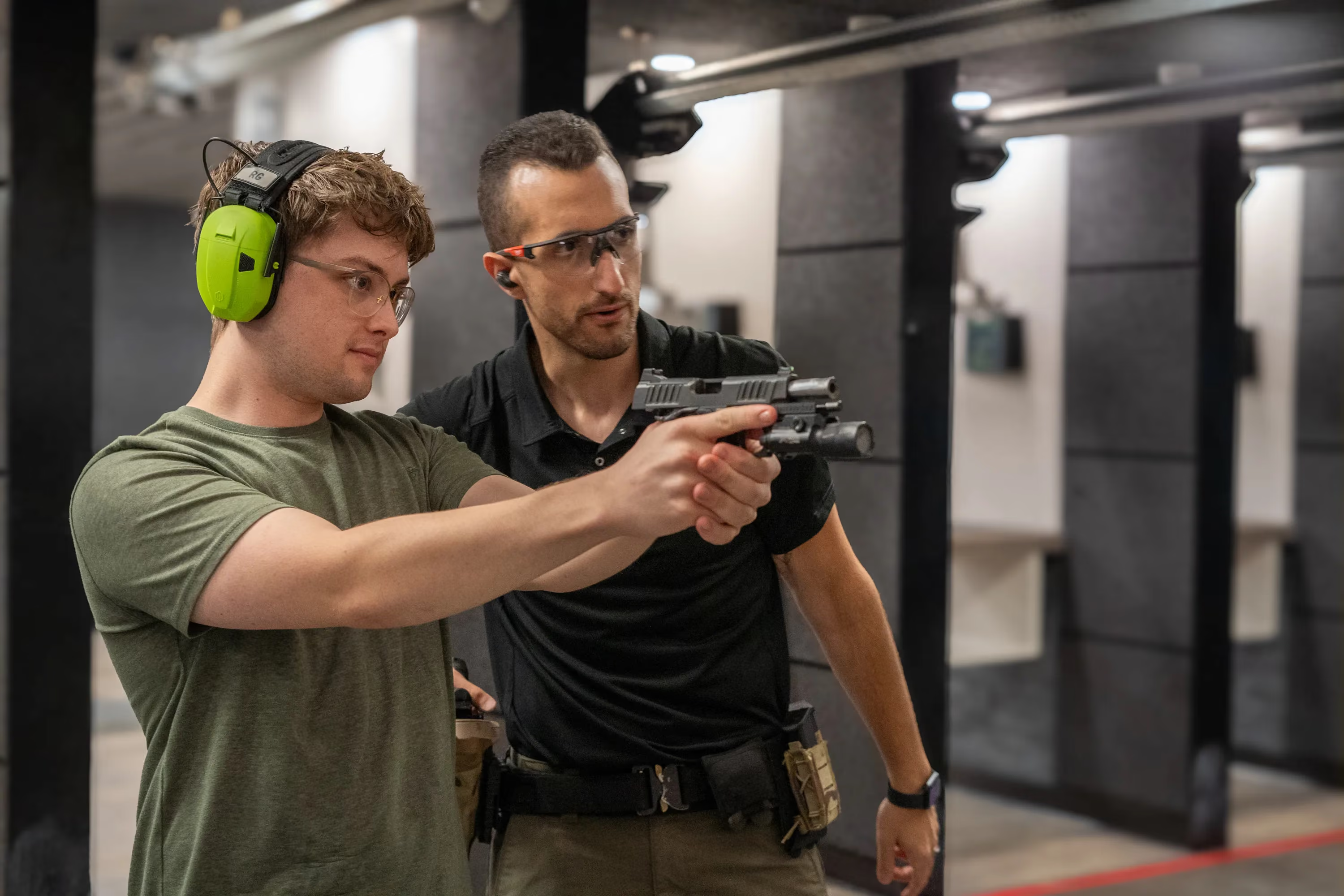
We teach beginners, first-time buyers, women, and LGBTQ+ students across the DFW area, one-on-one and in small groups, without the attitude you might be bracing for. News like this brings a wave of new people into the sport, and the most useful thing any of them can do is get real instruction first.
A private lesson starts at $119 and includes the range, the firearm, and the ammunition. If you are still figuring out what to buy, Try Before You Buy is a 90-minute session built around exactly that, so you do not spend $700 on the wrong gun.
Last reviewed August 11, 2026. General information, not legal advice, and this story is moving fast. Buying through a licensed dealer is low risk, that is the dealer's job to get right. If you are considering something with real exposure, like building a short-barreled rifle at home or taking possession of an unregistered item because you believe you are covered, that is when it is worth a call to a firearms attorney. For the record, the case is Silencer Shop Foundation v. ATF, consolidated with Jensen v. ATF, decided by Judge James Wesley Hendrix of the U.S. District Court for the Northern District of Texas on August 5, 2026. Details of plaintiff organizations and companies here are drawn from press coverage of the judgment.
Book a private, judgment-free lesson with L4A. Beginners always welcome.
Book a LessonInclusive, judgment-free firearm instruction in the Dallas–Fort Worth area.
DISCLAIMER: Liberty for All Training Co. ("L4A") is a certified firearm safety instruction company serving the Dallas-Fort Worth (DFW) area. We provide in-person safety education and skills training only. We do not retail or broker the sale of firearms, ammunition, or weapons. Ammunition consumed during instruction is included as part of lesson pricing and is not sold separately.